
Facebook Internet Satellite Destroyed in the SpaceX Explosion
Facebook Internet Satellite Destroyed in the SpaceX Explosion

Facebook Internet Satellite Destroyed in the SpaceX Explosion

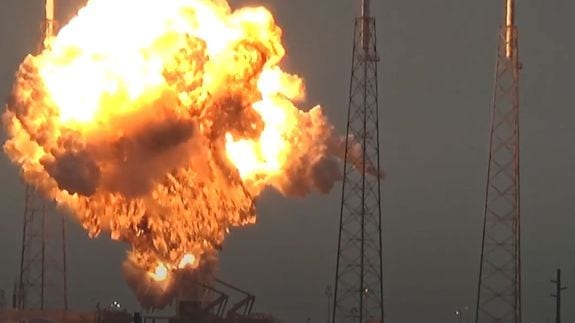
There was some bit of bad news for internet accessibility in Africa Yesterday (Thursday, September 1, 2016) as the rocket that was supposed to launch a Facebook Internet Satellite that was targeted at delivering affordable high speed internet to users in Africa and other regions exploded at the NASA launch site in Florida taking the payload with it.
The SpaceX Falcon 9 rocket was billed to launch the Facebook Internet Satellite to space on Saturday, September 3, 2016, but went up in flames during a routine test at its Cape Canaveral launch pad on Thursday morning.
The CEO of SpaceX Elon Musk tweeted that the explosion occurred during “propellant fill operation” and that it “Originated around upper stage oxygen tank”. The tweet also said the cause of the explosion was still unknown.
In its official statement about the mishap, SpaceX said
“At approximately 9:07am ET (1307 GMT), during a standard pre-launch static fire test for the Amos-6 mission, there was an anomaly at SpaceX’s Cape Canaveral Space Launch Complex 40 resulting in loss of the vehicle,”
Thankfully, there were no injuries as a result of the explosion, but the destruction of the satellite left the CEO of Facebook  Mark Zuckerberg, who was on a tour of Africa when the news broke, “deeply disappointed”.
The Facebook Internet Satellite, Christened the Amos 6 satellite was built by Israeli company SpaceCom and was part of a collaboration between Facebook and French Satellite Operator, Eutelsat.
The collaboration was aimed at delivering fast and affordable internet to most of Sub-Saharan Africa.
For now, it is not clear were this explosion leaves the ambition by Facebook to beam internet via satellite to people in Africa.
However, Facebook’s CEO did hint that the company is still committed to the broader objective of connecting everyone. Whether the Facebook Internet satellite solution will remain part of the  mix is not clear at this time. We will probably know more in the coming days, weeks, or months.

Facebook Internet Satellite Destroyed in the SpaceX Explosion was last modified:September 2nd, 2016 by Paschal Okafor

Comments

Popular posts from this blog

5 Most Incredible Engineering Projects in The World

5 Most Incredible Engineering Projects in The World What makes incredible engineering projects? Is it their scale, their use of cutting-edge technology, or their imagination in taking on what seemed to be almost impossible engineering feats? Project Management Training for 5,000 Naira Some of the most impressive modern examples of engineering have ranged from the development of super particle accelerators like the Large Hadron Collider through to Dubai’s artificial islands, and the tallest building in the world (at least for the present anyway). While some of these projects are still experiencing some problems, their achievements deserve closer inspection: Project Management in Nigeria The Large Hadron Collider Created by CERN between 1998 and 2008, the Large Hadron Collider is a giant particle accelerator used in high energy physics research. Its main aim has been to identify examples of the Higgs Boson theory and the foundational stages of mas...

contact

Contact. Your Name Your Email* Your Message*    Telephone: Call Fauzan on zulfauzan20@gmail.com  (9am to 5pm, Monday to Friday). Please before calling or contacting note that  Bro Fauzan .  We maybe sell products . If you want to buy and sell a product, we recommend our retail partner, Fauzan, Just call 01150021061   brofauzan is based in......  Click Here  if you are looking for details on how to Advertise on Brofauzan.blogspot.com Another website, wanfaco.blogspot.com wanfacoprinting.blogspot.com

A Large Asteroid Could Hit the Earth in 2032

A Large Asteroid Could Hit the Earth in 2032 A large Asteroid called 2013 TV135 with an estimated size of about 400 metres and force equivalent to 2500 nuclear bombs could hit the earth on August 2032 according to Ukrainian astronomers at the Crimean Astrophysical Observatory in the Ukraine. However, NASA has issued a reality check saying that the probability of an impact is only 1 in 63000. [Image from NASA, Click to Enlarge] This means that the probability of the Asteroid not impacting the earth is 99.998%, which is quite huge. However, this discovery is significant because of the 10,332 near-Earth objects being tracked by scientists as of October 14, the 2013 TV135 is the second most dangerous. The most dangerous is a smaller Asteroid called 2007 VK184 about 128 metres wide with a probability of 1 in 2700 of hitting the earth in 2048. For comparison, the Asteroid that wiped out the dinosaurs about 66 million years ago was about 9.6 km (9800 metres) wide...